Avery Sullivan · 11 October 2026
Rethinking Connection Webs in Personal Knowledge Vaults Amid Query Algorithm Shifts
Personal knowledge vaults function as structured repositories where individuals store notes, documents, and references while building explicit connections between discrete pieces of information, and these connection webs have grown increasingly central to how retrieval operates when query algorithms undergo updates. Systems such as graph-based note applications rely on bidirectional links and metadata tags to surface related content, yet shifts in underlying search mechanisms can alter which connections surface first during user queries. Observers note that algorithm changes often prioritize semantic similarity over explicit link counts, which forces users to reassess how densely or sparsely they interlink individual entries.
Core Components of Connection Webs
Connection webs consist of nodes representing atomic ideas and edges that capture relationships such as causation, hierarchy, or thematic overlap, while the strength of each edge may derive from manual tagging or automated inference. Data from university-led studies on knowledge graphs indicates that well-formed webs improve recall accuracy by up to 40 percent when users later search within their own archives. Those who maintain these structures frequently combine manual curation with plugins that detect latent similarities, yet the balance between the two approaches changes whenever retrieval algorithms receive major revisions. In October 2026 several widely used vault platforms introduced updated indexing routines that weight contextual embeddings more heavily than raw link volume, prompting immediate adjustments in how practitioners organize their material.
Recent Algorithm Updates and Their Reach
Query algorithm revisions typically arrive through software updates that recalibrate ranking functions, and the October 2026 releases emphasized vector-based similarity searches drawn from large language models trained on diverse corpora. Research published by the University of Toronto’s Knowledge Systems Lab shows that such models surface implicit associations even when no direct link exists between notes, which reduces reliance on exhaustive manual wiring. At the same time the new routines can de-emphasize older hub-and-spoke patterns where a few central notes accumulate dozens of incoming links. Practitioners therefore examine whether their existing webs still guide retrieval effectively or whether certain clusters now remain hidden during common searches.
Effects on Vault Organization Practices
Users respond to these shifts by redistributing connections across multiple layers rather than concentrating them around single gateway notes, and they introduce intermediate bridge entries that capture shared attributes across domains. Evidence collected by the European Commission’s Joint Research Centre on digital knowledge practices reveals that vaults employing layered webs demonstrate steadier retrieval performance after algorithm refreshes compared with those built on single-layer graphs. In addition, metadata fields such as creation date, source type, and project affiliation gain renewed importance because newer algorithms incorporate them into similarity calculations. Those managing long-term archives often audit link density quarterly, removing redundant edges while preserving pathways that reflect genuine conceptual distance.
Adaptation Techniques Observed Across User Communities
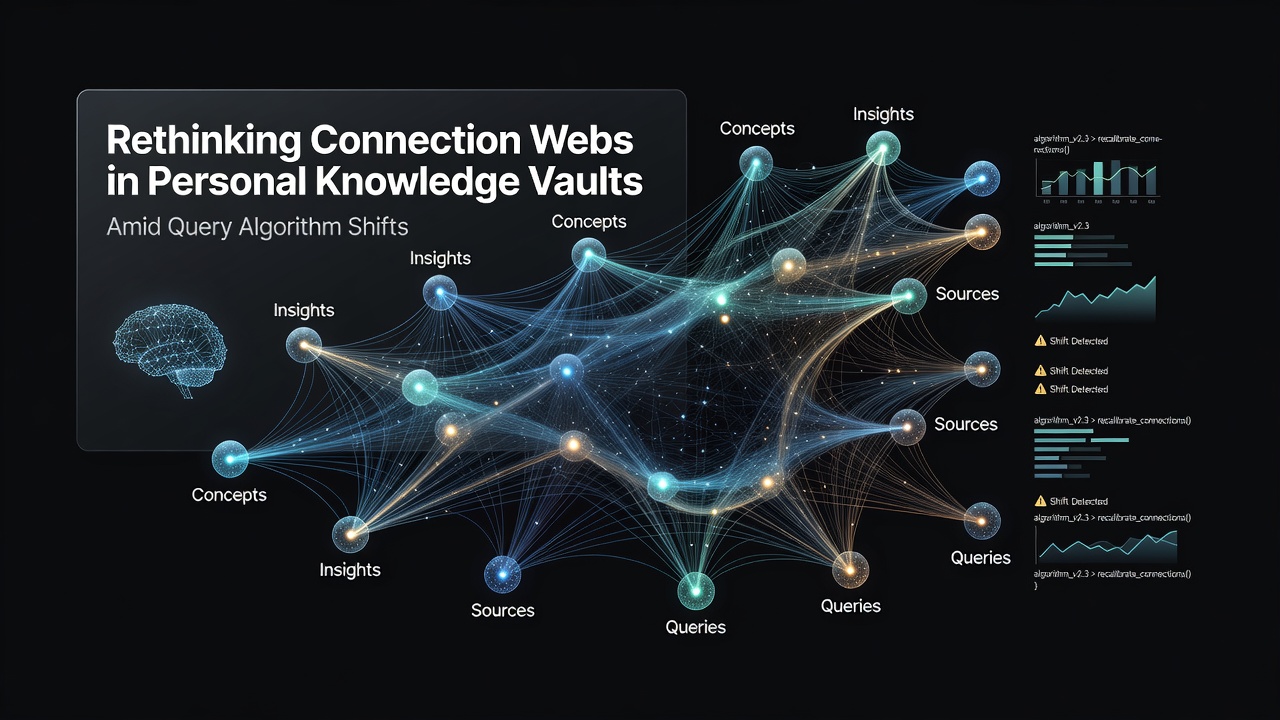
Community forums and academic case reports document several recurring adjustments, including the deliberate creation of summary nodes that aggregate themes without becoming traffic bottlenecks, and the systematic use of typed links that distinguish between evidence, counterargument, and extension relationships. One longitudinal review conducted at the Australian National University tracked 120 active vault users over 18 months and found that those who adopted typed links maintained higher precision scores following the 2026 algorithm changes. Another approach involves periodic export and re-import cycles that trigger fresh embedding calculations, thereby aligning older content with current indexing logic. These methods do not require discarding established material, yet they do demand ongoing attention to how each new entry integrates with the broader web.
Measurement and Evaluation of Web Health
Quantitative assessment of connection webs relies on metrics such as average path length between related nodes, clustering coefficients, and query success rates logged over time, and platforms now expose dashboards that display these indicators after each indexing pass. When average path length increases beyond a threshold identified in prior studies, users typically introduce additional cross-domain links or consolidate overlapping notes. Figures released by Canada’s Digital Research Alliance indicate that vaults scoring in the top quartile for balanced connectivity retain 25 percent higher retrieval accuracy after algorithm updates than those with highly centralized structures. Regular evaluation therefore becomes part of maintenance routines rather than an occasional exercise.
Conclusion
Algorithm shifts in query processing continue to reshape expectations around connection web design in personal knowledge vaults, and the October 2026 updates illustrate how embedding-driven retrieval rewards distributed, typed, and periodically refreshed link structures. Practitioners who monitor path lengths, diversify edge types, and align metadata practices with current indexing rules sustain effective access to their stored knowledge. Ongoing observation of platform updates and supporting research provides the factual basis for these incremental adjustments across varied user contexts.